
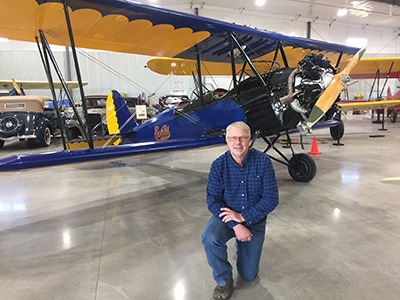
 Working in aviation offers so many varied experiences and opportunities. My last article for Midwest Flyer Monthly was all about encouraging kids to explore the wide ranges of aviation careers! So, this month, I want to dive into the aviation career I know best: what it’s like to work in an aviation museum.
People ask, what’s a typical day like at the Kelch Aviation Museum? The reality is, there’s no one typical day. Since we’re a small organization, every staff person wears many hats; I might be repairing an engine, decorating tables for a banquet, stocking the gift shop, or writing an article like this. One thing is always true, however: Every day provides a different challenge, a different learning opportunity, or a different accomplishment.
The most exciting part of the job is, of course, the airplanes. It’s all hands-on deck for flying days, big restoration projects, and any time we shift aircraft between hangars. Even the unglamorous task of moving aircraft by hand can take a team: Each aircraft in the collection has a character of its own, including how it handles on the ground when you’re moving it by hand – or trying to, anyway. The Butler Blackhawk, a classic 1920s beast of a biplane, has a locking tailwheel that has to be manually unlocked every time you turn it. To move our Fleet Model 7, the elegant regular flyer that “lives” closest to the hangar door, it’s easiest to simply disconnect the tailwheel cables to push it by hand – but don’t forget to reconnect before flight! Meanwhile, the Curtiss-Wright Travel Air 12W’s oil tank placement requires it be shut off manually when not in use, and to shut off the oil you must remove part of the cowling… So, the Dzus fasteners and a screwdriver sit on the wing, an unmissable reminder to always check the oil shutoff before operating. The E-2 Cub, Pietenpol, and Russel Light Monoplane all have tailskids instead of tailwheels, but luckily these three aircraft are so light, one person can simply lift the tail when pushing the aircraft. I can’t tell you how many zigzags we make across that floor, however, trying to wrangle the aircraft into presentation positions. A few years ago, a donor gave the museum a set of wheel dollies, an incredibly helpful tool for finagling the aircraft into precise showroom places.
This time of year, as we wind down the summer flying months, there are some winterizing tasks to do on the aircraft, and we’ll perform our semi-annual showroom hangar reshuffle before the cold and snow arrive. Shoehorning a dozen aircraft, a firetruck, five cars, three motorcycles, and multiple displays into one room, soon makes even 12,000 sq. feet feel small. We try to keep the showroom fresh and interesting so repeat visitors always have something new to explore. Finding the content isn’t an issue, but finding a way to present it in a cohesive way is a bit more of a challenge.
That brings us to exhibit and display planning. Led by Chief Curator (and skilled tailwheel pilot), Hannah Shickles, this winter we’re taking time to refresh nearly all of the museum’s existing exhibits. Every aspect of our displays is created from the ground up – research, writing, graphic design, sourcing artifacts, video production — you name it. This process can take months, so we’re lucky to have a quieter winter season each year to focus on quality exhibit design.
Airplanes and displays are key, of course, but the most important factor are the guests! Walking into the museum is often someone’s first introduction to general aviation, especially kids, and we want it to be overwhelmingly positive. For those more familiar with aviation, it’s equally important to us that they’re captivated and welcomed. One of the upsides of being such a small organization is being able to interact with guests on an individual basis, and each of our docents does a great job with this.
The glamour of working side by side with 90-year-old antique airplanes does fade a little day to day, so I’m always glad when a visitor comes in and I can revisit that excitement through their eyes once again. My favorite is asking airplane-crazy kids, “Would you like to sit in the pilot’s seat?” Since the museum is open 5 days per week, everyone on staff spends time “working the floor,” greeting visitors, running the gift shop, and giving tours. It’s a nice break from office work.
And speaking of office work: In an aviation museum, we spend a lot of time doing non-airplane tasks. Since we’re located on the eccentric and busy Brodhead Airport in Brodhead, Wisconsin, pilots and other airport visitors wander into interrupt – I mean, chat a lot. Today our incumbent EAA chapter president swung by to discuss plans to form a new flying club. Surprisingly, neither the Brodhead Airport nor EAA Chapter 431 currently have a flying club, so we’re very excited about the possibility of creating one, and the museum will be supporting it in any way possible. Of course, any impromptu meeting soon turns into a gab fest about the latest aviation news on the field. And the socializing and office work extend to the internet, making sure we reply to email inquiries about everything from luncheon rentals to aircraft wing measurement requests, and updating the website and social media.
At the end of each day, I check my to-do list, and invariably it’s longer than when I started the day. Ah well. Perhaps it’s not the most glamorous job, and certainly not the most efficient, but there’s never a dull day. For anyone interested in aviation, history, or just an unusual job that uses all parts of your brain, I would highly recommend trying their hand working at an aviation museum.
EDITOR’S NOTE: Ami Eckard-Lee has worked at the Kelch Aviation Museum for 8 years, and there’s probably something on her very first to-do list that still isn’t done. In the meantime, however, she helped raise $3-plus million, create the brand new three-building museum facility, launch an internationally viewed video series, and organize a team of more than a dozen skilled museum crewmembers. Ami is a licensed pilot, certified coach, and dedicated collector of dad jokes. You can reach her with questions, comments, or your favorite dad joke at ami@kelchmuseum.org.
