
 “Remember, you fly an airplane with your head, not your hands and feet.”
In October of 2025 I attended an FAA FAASTeam seminar. The content is always interesting and informative. I often come away with information I did not have or had not previously considered.
I have assumed in the past, and this assumption is what I base my flying articles on, that General Aviation (GA) pilots holding at least a Private Pilot’s License possess a certain level of flying skill, training, and knowledge.
I have concluded my assumption is, possibly, a bit too optimistic.
The FAA provides, through its regulatory scheme under Parts 61 or 141, the minimum requirements for flying skills and aviation knowledge. In addition, if you have been flying for a while, you have no doubt realized that, in supplementing the minimum requirements, there is a great deal of additional information that comes primarily through specifically-targeted training, or is gained by flying experiences, or is learned through experiences other pilots have shared.
Unfortunately, there are many GA pilots, and even some CFIs, who fall short of the minimum skills and knowledge necessary to stay safe. Incident and accident reports clearly reflect this. There are many reasons.
CFIs are the “basic building block” of the system. Sadly, some (but certainly not most) may be “time builders,” occupying the right seat for instruction only so long as they do not yet possess the number of hours necessary to apply for commercial, corporate, or airline jobs. When the magic number of hours is attained, they are gone. Newly-minted CFIs replace them. Rinse and repeat. This is the traditional GA model.
The model only works well if the CFIs (who eventually will be moving on) are also dedicated to learning and to teaching, concerned about their students’ success, and can offer instruction predicated on good flying skills, real-world experience, and practical flying know-how.
A low-time, inexperienced CFI may have been taught by another low-time, inexperienced “time builder” – resulting in a lack of fundamentals being passed on because the “teacher” never possessed the knowledge or skills in the first place. As they say, “You don’t know what you don’t know.”
What are the cycles of an internal combustion engine? What is a carburetor and how does it mix and meter fuel and air? What is carb ice and how may it form? How do you know if an aircraft engine has carb ice? What happens with the vertical component of lift during a 60 degree bank angle and why? What causes a wing to stall?
These types of questions are not simply academic exercises for written knowledge tests. A good CFI or a good GA pilot will not only be able to understand the “why” of these questions, but the “how” of the answers and, most importantly for a CFI, be able to adequately explain the answers to others.
The FAA and Designated Pilot Examiners (DPEs) are seeing an increase in incidents, accidents, and failed checkrides resulting from poor instruction, flawed aeronautical decision-making, lax Flight Reviews, bad habits, and lack of basic skills and knowledge.
The problems are not always with new pilots. For example, often the pilots who make the best landings are new pilots. Stands to reason, as they have the recency of experience, proficiency, a heightened level of precision, and an abundance of caution that some experienced GA pilots once possessed but apparently have forgotten.
Putting your airplane away for the winter months, difficulty in finding the time to fly and stay proficient when life or a job gets in the way, not adding to your skills and experiences, and only seeking out a CFI once every 24 months who is known for “easy” Flight Reviews, all contribute to incidents and accidents.
Over the next few months, I hope to use the Flying Experiences column to cover a few of these basic skills. This should not result in new information being imparted to pilots; instead, it should serve as a refresher course to remind most pilots of information they once knew, and can recall again, if prompted.
We can start with something simple – taxiing an airplane. How easy is that? Well, there are a few experienced pilots out there every year who badly wish they could have a “do over” after attempting a turn in a tight space and ending up with a wingtip or leading edge scrunched against a light pole, scraped or dented along a chain link fence, or paint “swapped” with another aircraft on the ramp.
Operating a GA aircraft safely does not begin with “wheels up” and end with a gentle touch down back on the runway. In fact, some of the most critical safety practices occur during ground operations – on ramps, aprons, and taxiways. These areas are bustling with activity: aircraft maneuvering, service vehicles moving, passengers boarding, and maintenance crews working. For pilots, mastering ramp and taxiway operations is essential to prevent accidents, maintain efficiency, and ensure compliance with FAA regulations.
The remainder of this article will provide an overview of the fundamentals of ramp and taxiway operations for GA pilots, covering terminology, hazards, procedures, communication, signage, and best practices.
The ramp, also called the apron, is the area where aircraft are parked, loaded, refueled, or boarded. It interfaces directly with terminals, hangars, and service roads. Hazards include moving propellers, jet blast, fuel trucks, baggage carts, foreign object debris (FOD), and perimeter fencing and lighting.
A taxiway is a defined path that connects runways with ramps, hangars, and other parts of the airfield. Taxiways are designed to provide safe, efficient movement of aircraft while maintaining separation from other traffic. They are marked with centerlines, edge lines, and lighting systems to guide pilots and provide adequate clearance for your aircraft’s wingtips.
Operating on ramps and taxiways exposes pilots to significant risks. Collisions account for a substantial number of ramp accidents during taxi, often involving other aircraft, fixed objects, or buildings.
Propeller/Jet Blast injuries, although uncommon, are a clear danger that must be accounted for. Walking into spinning propellers or being caught in jet blast can be fatal. This underscores our responsibility as PIC to be aware of people and surroundings while the engine is running.
FOD, such as trash, tools, tiedown ropes, wheel chocks, or loose objects can damage engines, propellers, or tires.
Noise and distractions, such as prolonged engine run-ups, can irritate other pilots, passengers, or others on the ramp or inside the terminal and in adjacent offices and hangars.
Runway Incursions, defined as entering a runway or taxiway without clearance (at a Tower-controlled airport) or without checking for and confirming the absence of conflicting traffic (at a pilot-controlled airport) are serious violations of the regulations.
Pilots must understand airport surface markings to navigate safely. To review:
- Taxiway Centerline (yellow line): Guides aircraft along the taxiway.
- Edge Markings: Define usable pavement.
- Taxiway lights: Blue.
- Hold Short Lines (black/yellow): Indicate where to stop before entering a runway.
- Black background/yellow inscription: Location signs.
- Yellow background/black inscription: Direction signs.
- Red background/white inscription: Mandatory instruction (e.g., “Runway Ahead”).
Clear communication with ATC is vital. Communication facilitates the organized flow of necessary information and increases safety for everyone. Listen to and copy ATIS. Always request a taxi clearance if required before moving. Write ATC instructions down as received on a kneeboard, notepad, or tablet prior to reading back. Read back hold-short instructions verbatim. Use standard phraseology (e.g., “Taxi to Runway 28, via Alpha, Bravo”) whenever possible. If necessary to employ non-standard phraseology, keep it short, simple, and to the point. If unsure of your position on the airport, ask ATC for “progressive taxi instructions.”
On the ramp, pilots should:
- Preflight carefully. Watch for tripping hazards like hoses, extension cords, chocks, and tiedowns.
- Maintain situational awareness. Observe traffic flow. Be aware of other aircraft starting up or operating around you and vehicle movements.
- Avoid distractions. Eating, smoking, or using a mobile phone can lead to accidents.
- Respect FOD rules. Dispose of trash properly. If you inadvertently drop something, immediately pick it up. You do not want to be responsible for your discarded litter being ingested by a jet engine across the ramp.
- Use proper lighting. Beacon/anti-collision lights should be activated just prior to engine start (a good signal to outside observers that your aircraft is about to fire up and move) and remain on when engine is running and aircraft is in motion.
- After one last scan of the area around the airplane, shout “Clear” or “Clear propeller” just prior to turning the key in the ignition.
- Test the brakes for proper operation as soon as the aircraft is in motion.
When taxiing:
- Taxi at a speed appropriate for the conditions. What may be a safe taxi speed under some conditions may be imprudent or hazardous under others. The perceived benefits of a fast taxi are outweighed by the potential safety risks. Exceptions are taxiing after landing on the runway, or back-taxiing on the runway, where a faster speed to clear the runway quickly may enhance safety.
- Be extremely cautious when using a runway as a taxiway.
- While taxiing in windy conditions, proper use of ailerons and elevator is essential. While using controls while taxiing may seem confusing, visualizing what you want the wind “to do” when it meets a particular control surface on your aircraft may be helpful.
- More engine power may be required to start the airplane moving forward, or to start a turn, than is necessary to keep it moving. When using additional power, anticipate retarding the throttle once the aircraft begins moving to avoid excessive acceleration.
- When taxiing, your eyes should be directed outside of the airplane. While the aircraft is in motion, avoid the temptation to program the GPS, tune the radios, adjust the air vents, or otherwise “multi-task.” Defer those items until you are stopped and can safely attend to them without distraction.
- Maintain spacing. Keep a safe distance from other aircraft. Beware of propwash or jet blast of other aircraft in front of you or to the side of you. Also, be courteous of other pilots and always be aware of your own propwash or jet blast.
- If maneuvering into a parking space, be aware of your surroundings and estimate distances to other aircraft or fixed objects (buildings, fences, light poles, etc.) accurately. If in doubt, shut down the engine and re-position by hand or call for assistance.
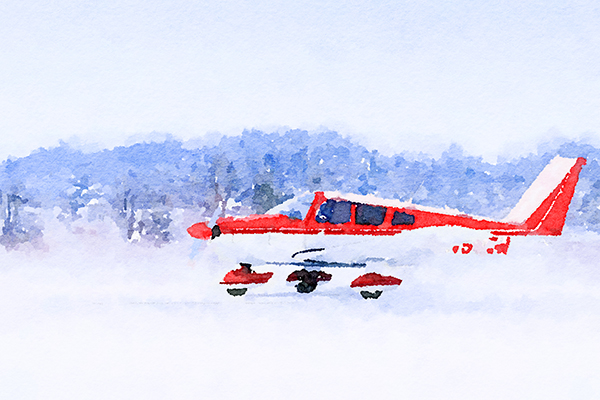
- If taxiing on hard-packed snow or ice, watch speed carefully and anticipate increased stopping distances.
- Use brakes smoothly. Avoid abrupt stops. Also avoid “riding” the brakes. Unless your aircraft has a free-castering type of nosewheel, use the rudder pedals to steer on the ground. Heavy use of the brakes for steering may greatly increase wear.
- Constantly monitor wingtip clearance.
- Stay on centerline. Remaining in the middle of the taxiway prevents drifting into parked aircraft, obstacles, brush, and snowbanks.
- Follow ATC instructions. Never cross a runway without clearance.
Best Practices for GA Pilots
- Know where you are on the airport and where you are going. Have the current airport diagram displayed on a screen or have a paper copy of the current airport diagram available.
- Plan taxi routes prior to taxi. Especially at unfamiliar airports.
- Identify complex intersections and “hot spots” in advance.
- Before crossing any hold short line, if in doubt, STOP. Confirm with ATC your clearance.
- Be vigilant if you accept a “position and hold” clearance.
- Stay alert at night and in poor visibility. Use lights and maintain extra caution.
- Avoid complacency. Most taxi/ramp accidents stem from carelessness.
- Coordinate with ground crew. Recognition and use of proper hand signals and radios help prevent miscommunication.
- Respect speed limits. Some airports enforce maximum taxi speeds.
- Practice sterile cockpit. No unnecessary conversation during critical phases of flight, including taxi, if warranted.
Taxiway and ramp operations affect the environment and surrounding community. Proper ramp etiquette is to be aware of and follow any noise abatement procedures. Avoid unnecessary or prolonged engine run-ups near areas where people may congregate or automobiles are parked.
Always observe proper and safe fueling practices. Double-check the correct fuel pump and follow the fuel pump instructions. Always use the grounding wire and secure to an appropriate metal ground on your aircraft prior to fueling. Prevent spills to protect groundwater. Efficient taxi routes reduce emissions and save fuel and money.
Operating an aircraft on ramps and taxiways requires discipline, awareness, and adherence to procedures. From understanding markings and signage to maintaining communication with other aircraft or ATC, every step is designed to prevent accidents and ensure smooth operations.
For GA pilots, the ramp and taxiway are as critical as the runway itself. Mastering these basics not only enhances safety but also builds professionalism and confidence in every flight.
DISCLAIMER: Mr. Zakos’s articles should not be used for flight training or misconstrued as instructional material. The articles represent the author’s personal opinions. Readers are urged to always consult with a Certified Flight Instructor and other sources about anything discussed herein.
© Copyright Dean Zakos 2026 All Rights Reserved
