
By Ron Henning
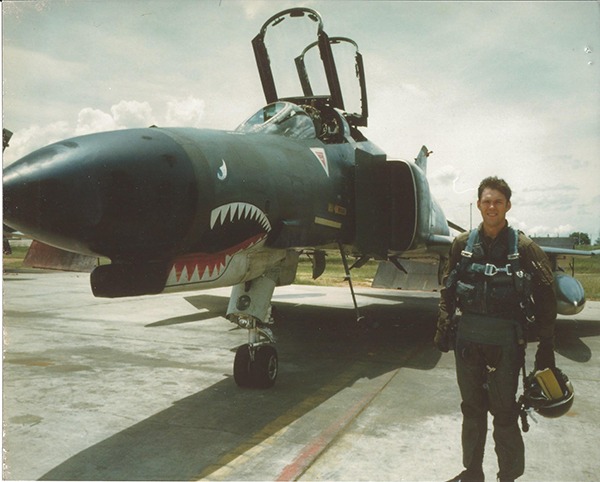
I knew from the time I was 4 years old I wanted to be a pilot. Fortunately, I grew up about 30 miles from Chicago O’Hare International Airport (ORD) and many United and American pilots lived there. A United pilot lived two houses down from me in our first home. My parents were friends with a very senior (hired before WWII) United Captain named Vern Finzer who was involved with a flying club based on one of the first “fly-in community” airports, Naper Aero Club (LL10) in Naperville, Illinois. He became my primary flight instructor. A DC-8 Captain at the time, Vern was one of the captains United used to “model” prospective new hires after. Later I flew with a United DC-6 pilot, and later Caravelle First Officer, Ken Anderson, who flew a Cessna 182 into ORD and asked for a job. Vern’s son, Mel, also instructed a little bit while in college and eventually was hired by United as a DC-8 Second Officer and got to fly a trip with his dad. LL10 was developed by Harold and Eva White who went to college with my parents. The Harold White Aviation Center at Lewis University was donated by Harold. There were two flying clubs based there, along with some hangared and tied-down aircraft. A United pilot who was an A&P lived there and maintained our fleet.
In December 1965, when I was 15 years old, my dad signed me up in one of the
flying clubs whose president was Lou Drendel who later co-founded the Lima Lima T-34 aerobatic team and became a world-renowned aviation artist and author. At the peak, our fleet consisted of two J-3s, an early Citabria that still had the Champ’s landing gear, a Cessna 140, two 150s, a 172 and our flagship 182.
It was cold on my first flight, and we had to de-ice a Cub as it had snowed. We
finished the first one only to find the throttle froze, so we cleaned up the second plane, and it was fine. One was 65 horsepower and the other 85. But I didn’t care about the cold or snow removal, as this was my dream coming true!
Vern showed me the float fuel gauge, the whiskey compass, and tach oil pressure
and altimeter gauges. The airspeed indicator was never mentioned!!! Definitely “old
school,” as I was taught to fly by the “TLAR” method…That Looks About Right. Vern
wanted me to feel the airplane and not fly by numbers, other than to be at the right pattern altitude. All approaches in those days were meant to be power off.
A farmer named Earl Matter had a grass strip about 10 miles away where we
practiced touch and goes. I couldn’t solo on my 16th birthday as we were on spring break in Florida, but we got home near the end of April 1966. There was a period that I didn’t fly much, mainly because of weather, but now spring had arrived and I could fly often. I had to work for my dad to earn the money, mostly yard work which I couldn’t do in the winter either. So long as my dad saw me work, he would always chip in for my lessons and in fact I probably only paid for 20% or so myself. He taught me that nothing in life is free and I had to earn everything.
I’m not sure the exact date I soloed, as my logbooks are in storage. I had somewhere
between 6 and 8 hours. After a few circuits, Vern said to make a full stop. He got out and said, “take it up and make two touch and goes and then a full stop to pick me up.” He told me how much better the airplane would perform without him in it. It was normal in those days to solo with less than 10 hours. It was such a surprise that I never had time to be nervous. Landings were OK.
So that was my first solo. I later checked out in all the club airplanes although I only
flew the Cessna 172 once (I later got my instrument rating in one, but that’s another story). I mostly flew the Cessna 140 as it was $1 an hour cheaper and 10 mph faster than the Cessna 150s, but I got both my private and commercial in 150s. My examiner on both rides was Delbert Koerner, founder of Koerner Aviation, whose license was signed by Orville Wright. Delbert had his own strip on his farm. His wife ran the desk, his brother ran a machine shop, and they both farmed and ran the aviation business. Their business is still located at the Kankakee, Illinois airport (3KK).
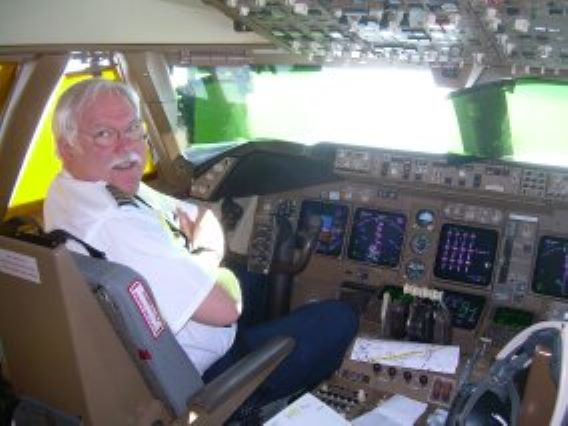
My last flight was in December 2014, so 49 years almost to the day in aviation. I’m
very fortunate not to be one of those folks who say, “I wish I had.” Instead, I can say, “I’m glad I did!”
EDITOR’S NOTE: Ron Henning retired as a Delta Captain on the 747-400 and was
also a captain on the Convair 580, DC-9, MD-80, B-727, A-320 and DC-10. In his spare
time, he created the “Astro Jet” airshow act with a BD5J Microjet, along with two other
airline pilots, which evolved into the “Bud Lite Jet,” flown by another airline pilot, 1980 World Aerobatic Champion Leo Loudenslager and Ed Johnson. Ron is currently living near Chiang Mai, Thailand, with his wife, Marisa.