
In my “Instrument Flight” column in the September 2025 issue, I addressed amended flight clearances and better ways to use our avionics packages to make changes. The article entitled “We Have an Amendment to Your Routing,” emphasizes simple reroutes and gives an extreme example of what a pilot may have to copy, readback and comply with:
ATC: “N2852F, we have an amendment to your routing…advise when ready to copy?”
N2852F: “N2852F, ready to copy.”
ATC: “After crossing the DELTA intersection, fly a heading of 240 degrees to intercept and track the 090-degree radial of the CBS VOR to cross CBS at 7,000, then direct to the FOXYY intersection via the MARY-3 Arrival for the RNAV/GPS 33 approach to the PODUNK Airport. Contact PODUNK approach on 127.65 upon crossing DONKY. PODUNK ATIS is available on 119.90.”
N2852F: “Roger.”
At the time the article was published, I had heard that some new technology in general aviation would lead to this article on Controller Pilot Data Link Communications (CPDLC).
CPDLC is now available for the Garmin GTN 750Xi and several other Garmin navigators through integration with the GDR 66 VHF Data Link (VDL) Mode 2 transceiver. This capability allows pilots to communicate with select air traffic control facilities via clear, text-based communications, enhancing safety. Garmin’s FAA Data Comm solution also allows properly equipped aircraft to load clearances, frequencies, and more, directly to their Garmin navigators. It is designed to reduce errors, more easily receive clearances, and send requests on crowded frequencies.
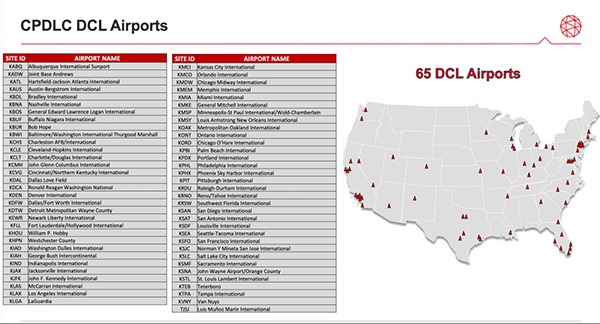
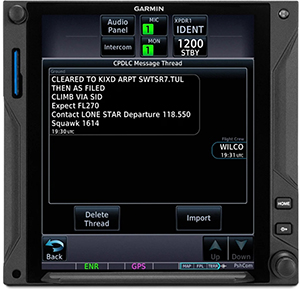
Currently, there are more than 65 airports that allow pilots to receive their clearances with this system on the ground (see FIG 1). After checking their clearance, the pilot needs to acknowledge the clearance within 100 seconds, and it is then auto loaded into the flight plan of the Garmin navigator (see FIG 2).
CPDLC primarily uses the ground frequency of 136.975 MHz worldwide like 121.9 MHz is used for voice ground control. Once airborne, ATC sends a data link request to the aircraft to change the CPDLC frequency, which the pilot must also acknowledge within 100 seconds. At any time, if the pilot fails to acknowledge data link communications from ATC, ATC will attempt to contact the pilot on the normal voice frequency.
According to information I obtained from someone at FAA headquarters in Oklahoma City, data link communications are available everywhere in the U.S. above 10,000 feet east of the Mississippi River, and above 16,000 feet west of the Mississippi River with the system expanding rapidly.
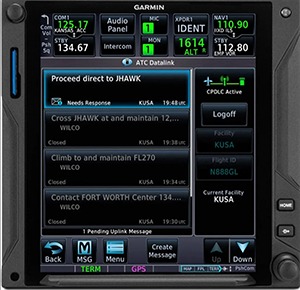
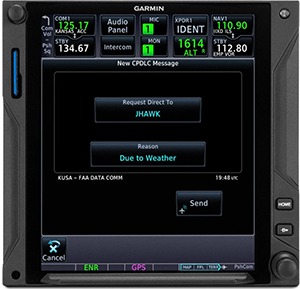
The big advantage to CPDLC comes with those reroute clearances while airborne. Once reviewed and accepted by the pilot, the clearance goes directly to the navigator (see FIG 3), eliminating miscommunication with ATC. No more readback or mistakes when entering the clearance into the navigator, especially at times of high workload or heavy turbulence. There are also times when the pilot needs to request a reroute for weather. The pilot can request a reroute (see FIG 4), and once approved by ATC, the pilot sends it to the navigator with the push of a button. There are several online videos from Garmin which further explain this new technology and how to implement it in your aircraft.
I have had several instances in the past where I wished I had CPDLC in my Bonanza.
One time while in heavy turbulence, I was given an amended clearance. While trying to program it into the navigator, I bumped something and ended up 1000 feet below my assigned altitude… a controlled flight into terrain (CFIT) accident in the making.
Another situation occurred at Meigs Field in Chicago while attempting to copy a clearance from a controller with a strong accent. That very same day, one of my former flight students had just returned from a flight to Mexico, and he too had an extremely difficult time copying a clearance due to the language barrier. He had CPDLC in his aircraft, but it was not available at the departing airport in Mexico.
Prior to Automatic Dependent Surveillance–Broadcast (ADS-B), some pilots (me included) equipped their aircraft with an Automatic Packet Reporting System (APRS) device that allowed for a bi-directional data communications position and weather (see aprs.fi). I could see, send, and receive text messages to and from fellow pilots thousands of miles away while airborne. CPDLC is an enhanced version of this technology using Automatic Dependent Surveillance-Contract (ADS-C), which uses an error correcting protocol that will eliminate many of our human errors. ADS-C is a data link surveillance system where aircraft automatically transmit position, altitude, and intent data to ATC in remote areas. It is used for oceanic/remote tracking, establishing “contracts” for data updates.
The future of flying, especially instrument flying, is again looking at the next technology enhancement to help keep our flying safe.
