
Two historic World War II-era aircraft from the National WASP WWII Museum in Sweetwater, Texas, will highlight the importance of women pilots during that period when the airplanes travel to Wittman Regional Airport for EAA AirVenture Oshkosh. EAA AirVenture Oshkosh, the 73rd Experimental Aircraft Association fly-in convention, is July 20-26 at Wittman Regional Airport in Oshkosh.
Representing the museum at Oshkosh will be two historic training aircraft that played a critical role in the wartime training pipeline at Avenger Field. The museum’s 1943 Vultee BT-13 Valiant and North American AT-6 Texan serve as flying reminders of the progression from basic flight instruction to advanced military aviation training completed by the WASP during World War II. Together these aircraft tell the story of how women pilots were trained to support one of the largest military aviation operations in history.
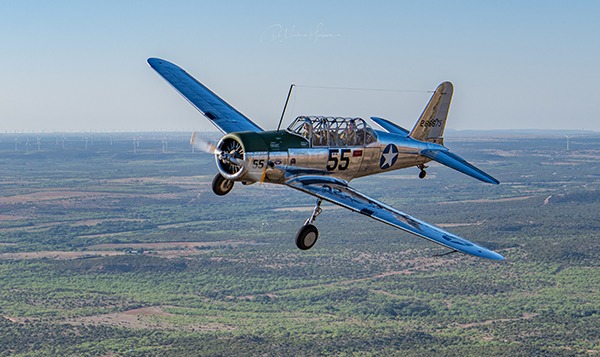
The Vultee BT-13 Valiant formed the foundation of military flight training for thousands of American aviators during World War II. Officially named the Vultee Valiant, the BT-13 was humorously nicknamed the “Vultee Vibrator” by pilots because of its powerful engine vibration, and it introduced trainees to heavier aircraft with greater complexity and performance demands. The museum’s silver BT-13, restored and donated in honor of WASP pilot Betty Wall Strohfus, appears in the same markings seen at Avenger Field during the war. This aircraft represents the stage of training where WASP trainees refined the precision flying skills needed before moving on to advanced trainers and operational aircraft.
The North American AT-6 Texan represented the final stage of advanced single-engine training for many WASP trainees. In the AT-6, pilots mastered aerobatics, formation flying, cross-country navigation, and instrument flight. The aircraft demanded discipline, precision, and confidence from every pilot who flew it. The museum’s AT-6D was built in Grand Prairie, Texas and served at Luke Field, Arizona, one of the Army Air Forces’ largest advanced training bases during World War II. Of all the aircraft flown by the WASP, many later remembered the AT-6 as their favorite because of its speed, maneuverability, and direct connection to combat aircraft operations.
The training completed in aircraft such as the BT-13 and AT-6 prepared WASP pilots for vital wartime missions that directly supported America’s combat operations overseas. WASP flew every aircraft in the Army Air Forces inventory, including the twin-engine B-25 Mitchell bomber and the four-engine B-17 Flying Fortress. They ferried newly built aircraft from factories to military bases, transported cargo and personnel, towed aerial gunnery targets, and conducted test flights on repaired aircraft. Their service freed male pilots for overseas combat assignments during a critical period of the war.
Among the most remarkable chapters in WASP history was their connection to the B-29 Superfortress program. During the war, the B-29 developed a reputation as a dangerous and difficult aircraft to fly, causing hesitation among many male pilots assigned to transition training. In response, Colonel Paul Tibbets trained two WASP pilots, Dora Dougherty and Dorothea Moorman, to help demonstrate the capabilities and safety of the new B-29 Superfortress. At a time when the aircraft had developed a reputation for mechanical problems and dangerous handling characteristics, the WASP flew the B-29 to demonstrate the bomber to skeptical male pilots and commanders. Their professionalism, precision, and confidence in the aircraft helped restore trust in the B-29 program and supported the successful introduction of one of the most important bombers of World War II. The B-29 would later play a decisive role in the Pacific Theater and in bringing the war to an end.
AirVenture guests will have the opportunity to experience the sights and sounds of the same aircraft that trained the pioneering women pilots of Avenger Field. Through aircraft preservation, interactive exhibits, educational programming, and outreach initiatives, the National WASP WWII Museum continues to inspire future generations with the courage, leadership, and determination demonstrated by the WASP during World War II.