
“You can always go around, if it don’t look right comin’ down.” – from the song “Go Around” by Ken Davis
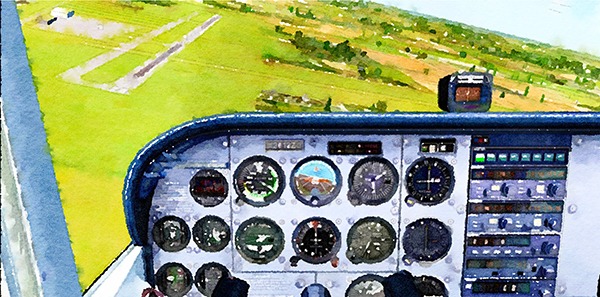
You are on final. Too high, too fast and, although it is not a “short field,” it is short enough to punish any sloppiness on your approach. Less than one-half mile from the runway threshold, you are right of runway centerline and well-above the glidepath. Your aircraft is not stabilized.
You have two choices:
- Attempt to salvage the landing; or
- Execute a go-around.
This is the fourth article in my series on The Basics of Flying. As I explained in the initial piece posted online in Midwest Flyer Monthly (January 2026), “[t]his should not result in new information being imparted to pilots; instead, it should serve as a refresher course to remind pilots of information they once knew, and can recall again, if prompted.”
A go‑around is one of the most fundamental safety maneuvers in general aviation (GA), yet it remains one of the most under‑practiced and under‑appreciated. Pilots spend hours perfecting landings, but the go‑around – the maneuver that saves you from a bad landing – often receives far less attention.
Why don’t GA pilots go-around more often? Short answer – ego. Often, pilots consider having to go-around an admission of a screw-up. Few pilots want to publicly admit a mistake.
In reality, a well‑executed go‑around is a hallmark of good airmanship. It reflects discipline, situational awareness, and a commitment to safety over pride or convenience.
This article explores what general aviation pilots should prepare for before entering the pattern, what constitutes a stabilized approach, how to make the go‑around decision, and suggests a step‑by‑step process for executing the maneuver smoothly and safely.
Preparing for the Possibility of a Go‑ Around
A go‑around begins long before the throttle is advanced. It starts with mindset and preparation.
Expect to go-around every time. Pilots should brief themselves before every approach – VFR or IFR – that a go‑around (IFR missed approach) is not only possible but normal. This mental framing removes hesitation and promotes anticipation. When you expect the maneuver, you are far more likely to execute it promptly and correctly.
A simple internal briefing may be, “If the approach becomes unstable, if spacing deteriorates, if the runway becomes unsafe, or if anything just “feels” wrong, I will go around.” This primes your brain to act decisively.
Know in advance your aircraft’s go‑ around configuration
Every airplane behaves differently when transitioning from landing configuration to climb:
- How much right rudder is needed with full power?
- How aggressively the nose pitches up?
- How quickly should flaps be retracted?
- How the airplane accelerates with partial flaps?
Pilots should review the recommended go‑around power setting (usually full power), initial flap retraction step, target pitch attitude, and best climb speed (Vy or a manufacturer‑recommended go‑around speed).
Anticipate Environmental Factors
Wind, density altitude, runway length, and obstacles all influence the go‑around profile. A short runway with tall trees off the end demands a different mental model than a 6,000‑foot runway with open fields beyond.
Before entering the pattern, ask:
- If I go around, what direction will I turn?
- What altitude will I climb to before re‑entering the pattern?
- Are there noise‑sensitive areas or obstacles?
- If tower-controlled, what is the tower likely to request?
- If IFR, what is the initial heading and altitude for the published missed approach procedure?
A pilot who has already visualized the maneuver will perform it with far more confidence.
Understanding the Stabilized Approach
A stabilized approach is the foundation of safe landings – and the trigger point for many go‑around decisions. The concept is simple: the airplane must be on a predictable, controlled, and safe flight path by a certain altitude. This is standard operating procedure (SOP) for Part 121 air carriers and Part 135 air charter operators.
Key Elements of a Stabilized Approach
While specifics vary slightly by aircraft and operator, most stabilized‑approach criteria include:
- On the correct glidepath (visual or electronic);
- Airspeed within a narrow band (typically +10/–5 knots of target);
- Constant descent rate (usually 500 – 700 fpm unless conditions require otherwise);
- Aligned with the runway centerline;
- Landing configuration set (flaps, gear if retractable);
- Power set appropriately for the descent; and
- Only small corrections needed to maintain the glidepath.
If you are fighting the airplane, making large power changes, using excessive bank angles, or chasing the needles, the approach is not stabilized.
The Stabilization Gate
Informed GA pilots use 500 feet AGL as the stabilization “gate” for VFR approaches and 1,000 feet AGL for IFR approaches. If the airplane is not stable by that point, the safest choice is to go around.
The gate removes ambiguity. It prevents the pilot from trying to salvage an unstable approach all the way down to the flare. There is no time for dithering on final approach. The gate makes it a black-and white-decision.
But, you may respond, “If I am a little high on final, I can always slip the airplane.” True. However, for some pilots, a slip could be a risky maneuver, particularly if they are low-time or not confident in or proficient at slipping to lose altitude close to the ground.
Do you practice slipping your airplane on a regular basis? From various heights and in different cross-wind conditions? How many landings and hours per month in your logbook? I am not against slipping; it can be a worthwhile skill to possess and a useful tool on occasion. I just believe, for many GA pilots, the go-around is often the better, safer choice.
When to Make the Go‑ Around Decision
The decision to go around should be immediate and unemotional. Pilots get into trouble when they try to “make it work” instead of recognizing that the approach is no longer safe. A pilot should initiate a go‑around if:
- The approach is unstable at or below the stabilization gate;
- Airspeed is significantly above or below target;
- The airplane is too high or too low;
- Excessive sink rate develops;
- Another aircraft, a vehicle, or wildlife enters the runway;
- ATC instructs a go‑around;
- A gust, wind shear, or ballooning destabilizes the flare;
- A significant cockpit distraction occurs;
- The pilot is not mentally or physically ready to land; or
- The runway environment is not in sight at minimums (IFR missed approach).
Easy to Remember Go-Around Rules
The “Three Second Rule” – If you find yourself thinking, “Should I go around?” for more than three seconds, the answer is “Yes.” Doubt is a sign that conditions are no longer ideal.
The “First Third Rule” – If you are not down on the first third of the runway, power up and go around. Leaving too much runway behind you and attempting to force the aircraft on with little runway remaining is a good way to make new friends at your local FSDO and end up in the NTSB Reports.
Removing Ego from the Equation
Many pilots hesitate because they feel a go‑around is an admission of poor flying. In truth, it is the opposite. Professional pilots go around when SOP requires it. Flight instructors encourage it. Designated Pilot Examiners (DPEs) expect it if the approach is not stable. Safety programs celebrate it.
When I was flying out of Fond du Lac, WI (KFLD), I witnessed a discussion between a DPE and a few local pilots in the terminal lobby. The pilots had watched a student pilot on his checkride with the DPE go around three times prior to making a successful landing. After the checkride, one of the pilots remarked to the DPE, “I bet you failed that guy.” “No, the DPE responded. I was happy to pass him. He showed good judgment in his decisions not to force a landing when the approach was not stabilized.”
A go‑around is not a failure – it is sound aeronautical decision-making.
How to Execute a Smooth, Safe Go‑ Around
Once the decision is made, the pilot must act promptly and methodically. The goal is to transition from a low‑energy landing configuration to a high‑energy climb without losing control or over‑controlling the airplane.
There are numerous videos available on YouTube of GA pilots failing to properly execute a go-around. Three often cited causes are: (1) Aircraft. High horsepower, high performance aircraft that produce a significant left-turning rotation (torque, P-factor, spiraling slipstream, gyroscopic precession) that surprises the pilot when already at a high angle of attack; (2) Flaps. Failure to raise the flaps or to raise them too quickly or all at once; and (3) Pitch/Airspeed. A high pitch angle combined with a slow airspeed. Each of these scenarios could result in a stall/spin accident.
Below is a widely accepted sequence, adaptable to most GA aircraft, to perform a go-around.
Step 1: Apply Full Power Smoothly
Advance the throttle to full power while maintaining directional control. Expect:
- Left‑turning tendencies;
- A strong pitch‑up moment; and
- A need for immediate right rudder.
Smooth but decisive throttle application reduces yaw and helps the airplane accelerate cleanly.
Step 2: Establish the Correct Pitch Attitude
As power comes in, push the yolk slightly forward to establish a safe airspeed – typically enough to begin a positive rate of climb without over‑pitching. Avoid the common mistake of aggressively pulling the nose up. Excessive pitch can lead to:
- Airspeed decay;
- A mushy, near‑stall condition; and
- Difficulty controlling the airplane.
Aim for a controlled, steady transition.
Step 3: Begin Initial Flap Retraction
Once the airplane is climbing and airspeed is increasing, retract flaps in increments. Consult the Pilot Operating Handbook (POH) for your specific aircraft. This reduces drag while maintaining lift.
Forgetting to raise the flaps on a go-around is an infrequent, but not uncommon, mistake. Aircraft will not climb as expected if the flaps remain fully extended. Inexperienced pilots may perceive the lack of performance on climb as an engine issue, when in fact it is the tremendous drag caused by the flaps not being retracted.
Retracting all flaps at once is also a classic error – it can cause the airplane to sink, settle back onto the runway, or stall.
Step 4: Confirm Positive Rate of Climb
Look outside first (in VFR conditions), then scan the vertical speed indicator, altimeter, and attitude indicator. When you have a clear, positive climb rate:
- Retract gear, if applicable:
- Retract the remaining flaps gradually;
- Continue trimming as needed; and
- Maintain a safe climb speed.
Consult the POH for your specific aircraft.
Step 5: Follow ATC Instructions, Standard Pattern or, if IFR, the Missed Approach Procedure
If in a towered environment, expect instructions such as:
- “Fly runway heading;” or
- “Make left closed traffic.”
If in a non-towered environment, follow your pre‑briefed plan:
- Climb straight ahead;
- Re‑enter the pattern as appropriate; and
- Maintain situational awareness of other traffic.
Step 6: Clean Up and Re‑ Stabilize
Once at a safe altitude:
- Ensure landing gear is retracted, if applicable;
- Ensure flaps are fully retracted;
- Re‑trim, if necessary;
- Verify mixture, prop, and fuel pump settings; and
- Re‑establish situational awareness.
Only after the airplane is fully stabilized should you begin planning the next approach.
Common Errors and How to Avoid Them
Even experienced pilots can fumble a go‑around. Awareness of common pitfalls helps prevent errors.
Delayed Decision-making
Delayed decision‑making creates messed-up go-arounds. A dangerous error is waiting too long. A late go‑around can lead to high sink rates, loss of control, or insufficient runway remaining. Use your stabilization gate SOP. Commit early.
Over-pitching the Nose
When adding full power, most GA aircraft will pitch up, creating an unsafe angle of attack. Over‑pitching can cause an immediate stall warning. Control airspeed by pushing forward on the yolk appropriately.
Rather than allowing a large change in pitch attitude when going to full power, some CFIs suggest maintaining a level pitch attitude for a moment, building some airspeed, then making a gradual increase to the recommended pitch angle/climb speed. If you are not proficient or comfortable in going around, spending some time with your CFI is highly recommended.
Proper Flap Management
Raising all flaps at once removes lift faster than the airplane can accelerate. Forgetting to raise the flaps is also problematic; airspeed and climb performance are substantially degraded.
Retract flaps in stages.
Anticipation and Use of Right Rudder
Full power at low airspeed demands strong right rudder. Neglecting it leads to yaw, drift, and sloppy control. With high horsepower engines, a rapid increase in throttle may lead to an uncontrollable roll to the left if heavy right rudder is not immediately employed to counteract.
Go-Around Priorities
A go‑around can be busy. “Aviate, Navigate, Communicate.” – in that order.
Pilots must always fly the airplane first, avoid tunnel vision, maintain awareness of traffic, hold runway alignment or a parallel side-step course, and make a radio call, as well as executing the maneuver safely. However, the lowest priority is the go-around radio call.
A pilot who goes around demonstrates good judgment, discipline, situational awareness, and a commitment to safety.
Careful GA pilots go around because they refuse to force a landing. They understand that every approach is unique – a work-in-progress – and every landing is optional until the wheels are safely on the ground.
Note: The song “Go Around” by Ken Davis can be found and enjoyed on music streaming apps such as Apple Music, Google Play, Spotify, and YouTube.
DISCLAIMER: Mr. Zakos’s articles should not be used for flight training or misconstrued as instructional material. The articles represent the author’s personal opinions. Readers are urged to always consult with a Certified Flight Instructor and other sources about anything discussed herein.
© Copyright Dean Zakos 2026 All Rights Reserved
