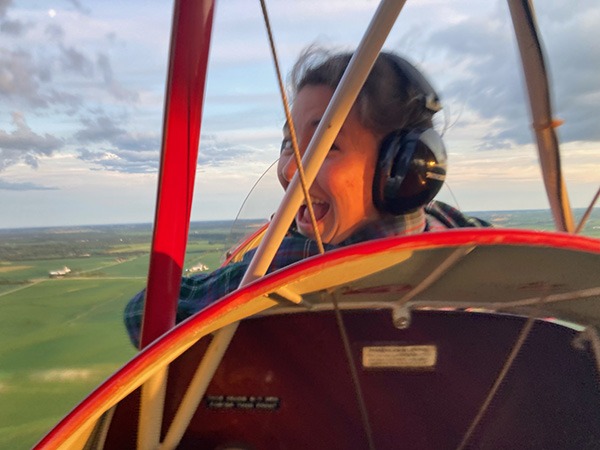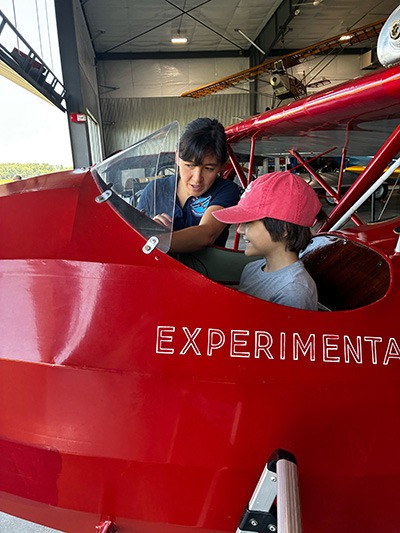
When I got my pilots license last year, the thing I was most excited about was giving rides to family and friends. They’ve all been hearing me talk about the thrill and magic of vintage open cockpit flying for years, after all! Introducing people to the quirks, challenges, but above all the joy of “flying back in time” as I think of it, has been full of surprises for me both as a pilot and a person.
Reactions to the little fabric and wooden “Dr Suess Plane” I fly, the Curtiss Junior, range from delight to doubt, but my favorite so far was that of a gentleman on a museum tour, who, coming around the front of the aircraft where the pusher propeller is hidden from view, asked me, “is this some kind of jet? I don’t see a propeller…” My father, a cautious and educated man of science, told me for years that he would never fly with me. “It’s not that I don’t trust you!” he would say, “just not until I don’t have any dependents.” When I pointed out that my kid brother will be 18 in just a couple years, dad added quickly, “well, not until I don’t have a mortgage.” But after experiencing open cockpit flight with a friend in a reliable Stearman, dad was warmed up enough to risk his life on a ride with me. And now who is my most frequent flying passenger? Yup.
There are of course lots of questions about the safety: of the aircraft, of the uncontrolled airport, of avoiding traffic, of the 80-year-old engine. I have found that the more you know about something, the less intimidating it is; the more knowledge you have, the better you can understand the actual risk level. Modern folks look at a 1931 aircraft and words like “rickety” and “dangerous” come to mind, but a little understanding of flight and design and they’re usually reassured. I always tell people “if you don’t like it, we can land – just give me a thumbs down.” No one has taken me up on this offer yet – no pun intended.
Perhaps it’s silly, but during my years of flight training I had been rehearsing in my head all the things to say to passengers, the careful briefing before a ride, and I was quite excited to actually give my first performance, so to speak. For a pusher like the Junior, the most important thing is to make sure nothing ever flies out of the cockpit – because anything loose would go through the propeller, and breaking the prop would cause immediate extensive disaster. I am not sure what the average person in 1931 would have had to empty from their pockets, but of course the biggest modern risk is the cellphone. I felt pretty darn clever when I ordered a pair of cheap universal phone lanyards so folks could snap pictures without a worry. Other modern improvements to my 1931 Time Machine include my digital stopwatch, noise canceling headphones worn over top of earplugs and a helmet (because it is louder than any other plane I’ve flown in) and an iPad kneeboard with Foreflight for longer cross countries.
With these conveniences, I feel like I have the best of both worlds – the freedom of old fashioned slow and low flying, and the convenience of texting my mom to say “I am about to buzz your house!” Sometimes I forget how incredibly unique a Junior flight is, but giving a ride to someone always brings that thrill back for me. In the sky, whether it’s 1931 or 2026, that kind of joy is timeless!