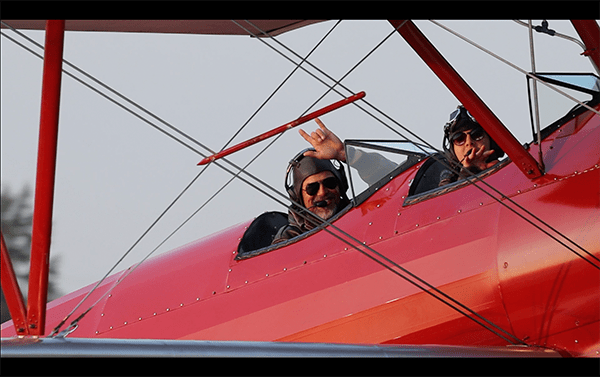
Although I’ve been attending Airventure for years, it’s always been by car: The first years as a spectator (I went several times as a kid totally uninterested in airplanes, just because my family lived nearby enough to go over out of curiosity), and more recently representing the Kelch Aviation Museum, acting as ground crew or support for aircraft that flew in.
As a pilot of strictly vintage aircraft with no radios and hardly any cross country range, I never planned or even hoped to fly into the busiest airport in the world. Honestly, the idea scared me: thousands of aircraft, thousands of pilots, thousands of people – what couldn’t go wrong? And like many low-time pilots, I wasn’t exactly keen to land in front of the largest airshow crowd in the world, especially not on pavement – I’m a grass runway kind of girl! Above all, it just didn’t seem practical: I’d be stranded without a car, hemmed in by traffic as slow as the Goodyear Blimp and as fast as an F16. No thank you, I’ll stay on the ground and go where I please, and if the drive is a hassle or the parking a drag, so be it.
But general aviation is full of the unexpected! This summer, our team was thrilled to be bringing a Kelch Aviation Museum airplane to Airventure for the first time in eight years: our 1946 Cub, made famous by pilot, Frank Baker and his book recounting adventures in it, “Cub Tales.” Although I was happily not pilot-in-command ferrying the Cub to and from Oshkosh (OSH) – that fell to my coworker Hannah Shickles, the perfect face for the museum in this endeavor – the weeks leading up to the flight were full of logistical planning and support, and I knew I’d be on hand throughout the week to help promote the museum and look after the Cub.
With a lot of publicity around Hannah’s successful Cub delivery, we needed a museum team on site, and I was signed up by default. But back “home” at the museum in Brodhead, it was another busy July week needing staff, with tours and guests and Oshkosh-bound drop-ins. Lucky for us, the trek to OSH isn’t far – a mere two hours by car. But commuting back and forth gets to be a hassle, and by Thursday afternoon as I wrapped up a wonderful museum tour for a group of kids from the Wisconsin School for the Deaf, I was ready to throw in the towel, abandon the team, and simply go home. A real shower and a real bed sounded awfully appealing after days of Airventure porta-potties, camper cots, and sunscreen…
But then who should pull up to the hangar but my friend Rich Pember – an un-ignorable entrance in his 1942 Stearman PT-27, engine roaring and red paint job shining in the sun. He had delivered a friend home and was about to head back up to OSH with an empty front seat in the Stearman, and would I like a ride back up?
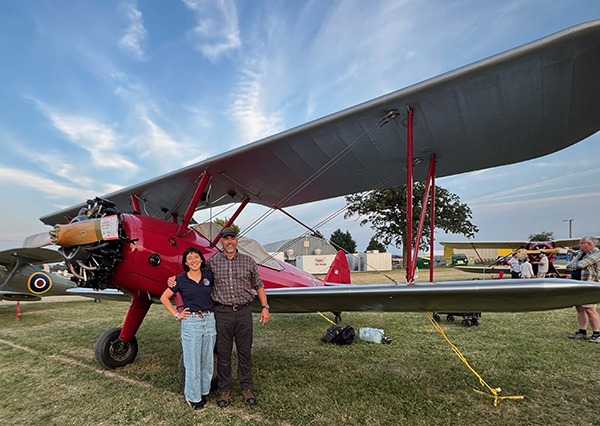 I don’t know about you, but I will never say no to an open cockpit biplane ride, even if it means forgoing a shower and a good night’s sleep. I grabbed my backpack and a tiny overnight bag – hearing echoes of “your carryon baggage is too large, ma’am” – hopped into the front cockpit, and put on the leather helmet with headset attached. With the Bose powered up, I could make as many sarcastic cracks about Rich as I wanted, knowing full well he would hear them all. We fly as realistically to the era as possible, but with all 9 cylinders roaring on the 225 Lycoming engine, noise canceling headsets are a necessity – I don’t want to be as deaf as a WWII vet if I can help it.
We took off into the afternoon sunshine, turned right, and headed towards Oshkosh at about 1200 feet AGL. The dark green lushness of Midwest July rolled out under us, fading at the edges with humidity and the last vestiges of wildfire smoke. My seat in the Stearman cradled me, comfortable and oddly secure, a cozy pocket roaring through the sky. In spite of the heat below, I felt chilly, glad for my sweater and Rich’s spare leather jacket.
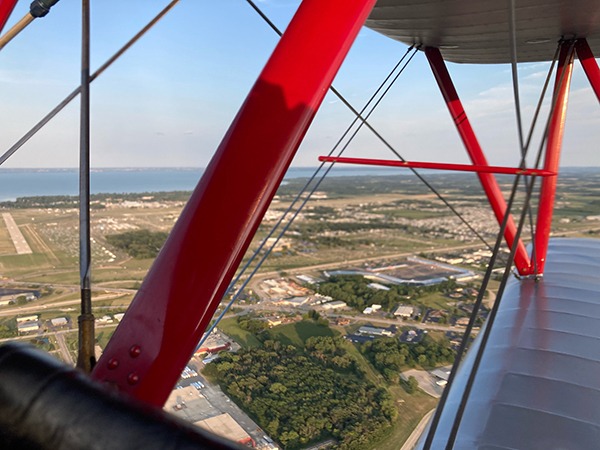
When I first flew in a small plane, I marveled at the continual suspension at that perfect “looking down” altitude – that altitude so fleeting in an airliner, only experienced in the minute and a half of a commercial flight’s beginning, when you can see cars and houses and people quickly shrinking from life size to toys to dots to nothing at all. It’s still one of my favorite things about general aviation. Our entire flight to Oshkosh we skimmed along just close enough to make out personal details, glimpses into the backyards and lives of those below: The turquoise disks of above-ground pools, the lines and squiggles of mower rows etched onto lawns, the spindly shadows of otherwise invisible flagpoles from above. How different each crop looked! Wheat already golden, sometimes shorn in crewcuts over the hills; corn topped with tassels; bean fields shimmering in green and silver waves as the wind turned the leaves.
Over the last few years Rich has flown into OSH during the airshow three times, and each time he’d flown with someone for their first ever OSH flight. This, his fourth, kept the tradition, with me on my first OSH arrival. Something I didn’t understand fully until I got my pilot license is the joy of taking someone with you – someone who is as excited and thrilled as you are – and now I know why Rich never says no to giving a ride.
We skirted the east side of Madison, passing Truax field from a respectful distance, just under the shelf of controlled airspace. Soon we were over land I’d only seen from the ground, the pine forests replacing farm fields, fulfilling every postcard stereotype of what “up north” should look like. Gradually Lake Winnebago slid onto the horizon, a burning silver line shining through the haze.
Approaching Green Lake, Rich still wasn’t picking up the Fisk arrival frequency on the radio. We climbed to 2000 AGL, throttled up, and flew in a severe slip, cockeyed sideways and up, attempting to expose the antenna to more direct signals. “It worked last time,” Rich said, laid back as ever, while we slid through the sky belly first above the lake, an attitude not unlike full throttle on a powerboat. Radio… Still nothing. I kept my head on a swivel for nearby traffic, squinting to make out any movement against the shining lake or chaotic foliage below; nothing and more nothing. The countryside remained peaceful, still, and silent to us. I checked the time; still not 6pm. Rich decided to land at Wautoma (Y50) and wait until the post-airshow arrival rush calmed, then try again to tune in to Fisk and join the evening conga line of aircraft arrivals before the airport closed at 8pm.
After a quick literal layover – spent laying in the grass by the FBO, soaking up the golden hour and monitoring the frequencies – we prepared for the last leg of our short cross country. I admired the Stearman on the ramp, bold and handsome in patriotic red, the oil streaks only adding to the effect; a real working airplane commands respect. What a gift to have flight, and friends, and the freedom to enjoy it on such a beautiful afternoon.
Above Green Lake the radio came to life. Still there was no sign of traffic, although ForeFlight indicated a steady stream of airplanes flowing towards OSH. I’d been hearing about the famous Fisk wing-rocking arrival procedure for years, but somehow assumed it would be more dramatic, more crowded, higher off the ground. Instead, we cruised eastward barely a thousand feet up, watching left and right, passing towns low enough to read billboards. What the flight lacked in traffic jam drama made up for in beauty and intricate procedure, a joy to witness in person at last.
I listened to the Fisk arrivals ATC team, peering through the windshield to try to see the plethora of planes they were directing, apparently just ahead of us. Still, we saw nothing. Then a high-wing Cessna of some kind – come on, I’m a vintage girl, can’t tell those things apart! – slid up behind us like an unexpected quartering tailwind. Its green stripes matched the trees below. Not wanting to interrupt the radio, I gestured to Rich, a universal signal probably employed in Stearman trainers since day one: Traffic! There! Though the Stearman cruises a generous 80mph, the Cessna gained on us. “Aren’t planes supposed to NOT pass here?” I asked Rich, curiosity overcoming my radio silence. “Yes…” Rich replied, accelerating, and flipped the smoke-oil switch. If you ever worry you’re invisible flying, a sudden cloud of billowing white smoke is the best alert in the world. I don’t think the pilot didn’t see us; I guess they just HAD to pass. We slowed and watched them whiz by. Why rush?
“If you’re not smiling, you can divert right now,” one of the Fisk ATC crew said over the radio. I laughed out loud. “Go ahead and get out of here if you aren’t having fun.” In spite of seeming to be alone in the air, I felt a camaraderie with the other pilots in the air near us. Then finally the call directed at us: “Hmm, is that a Stearman or a Waco, I can’t tell?” “Stearman!” Rich replied, and rocked his wings – in the extreme, because his goal is always to make the crew laugh. “Woohoo, great job!” I could hear the smile in the ATCer’s voice over the radio, and he added “I’m glad you’re here.”
Reading the NOTAM or writing of the experience seems bland now, but every moment is now burned in my memory. We followed the railroad, slowly descending, then came upon the airport almost suddenly, an oddly small area cluttered with planes of all sizes and a sea of campers – but not as enormous as it always felt on the ground. “Carb heat on, fuel mixture rich…” Rich went through his verbal checklist as I shuffled the papers to make sure of which colored dot came first, and then Rich turned onto final over a row of neatly parked fighters and an enormous Boeing jet. How strange, I mused, to fly over these modern sleek aircraft in this lovely lumbering Stearman, a Boeing Stearman at that. How wonderful that we’re allowed to do this – any general aviation pilot is welcome at OSH and treated with the same respect and care as anyone else on that legendary arrival procedure into the busiest airport in the world.
The runway rose gently to meet us. The heat from the day seemed to cushion our touchdown, and the engine at idle became a gentler sound, like a cat purring at rest. We floated above the orange dot, then the Stearman’s wheels met the pavement as soft as can be. “Right on target!” I exclaimed with delight. For a moment we rolled out in that same gentle idle, flying wires whistling in the wind, and I inhaled, thinking, that’s what flying into OSH should be.
“Hey Ami?” Rich said, and I turned in the cockpit to see him behind me. “Welcome to Oshkosh.”