
“I learned a little about flying that day, and a lot about myself.”
I was approaching 39 years old on the day I soloed. It was a Saturday, June 27, 1992. My account of that day, for which I cannot claim complete accuracy, is drawn primarily from my first pilot logbook and, honestly, my very selective recollection.
My logbook shows a total of 22.9 hours of dual given by that date. I started my aviation journey in March of 1992 on a cloudy, windy day. My wife and I lived, worked, and raised our family in Racine, Wisconsin. I was introduced to flying at Batten International Airport (KRAC), not far from our home.
My first Certified Flight Instructor (CFI) was Roger Licht. He was an experienced pilot, having held jobs as a corporate and airline pilot, as well as instructing for a living. He was also a genuine character. Not as many of those around airports today. We still decorate our Christmas tree with a cardboard fold-out “Santa in an airplane” ornament he sent me.
Roger always seemed to be hustling for new students or creating opportunities for additional ground instruction and flight hours. That is not unusual. He sold Shaklee vitamins and supplements out of the trunk of his car for additional cash. That was a bit unusual. He favored mnemonics with short, non -sensical words or phrases to reinforce checklists. For example, after engine shut down, “M&Ms are Good Food – Master switch, Magnetos, Gust lock, Flight plan closed.” I still recall that one. There were many more.
He was direct in his teaching style, could be abrupt when I displeased him, was slyly humorous at times, and was very good at explaining flying concepts, demonstrating techniques, documenting lessons, and performing post-flight debriefs, the latter frequently at a nearby restaurant on Rapids Drive after the lesson. He often enjoyed a bowl of peaches and cream to complete his meal.
Unfortunately, Roger lost his life in December 2002 on a night flight while returning to Racine. The Cessna 182RG Skylane went down in the water a few miles off the shoreline of Lake Michigan in view of the Chicago skyline.
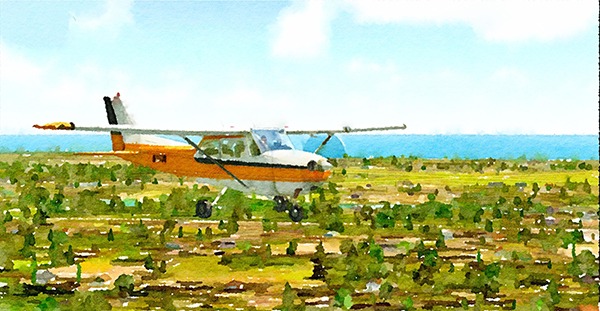
My initial flight lessons and my first solo were in a 1979 Cessna 172N Skyhawk, N2994E. In March, Roger arranged to meet me at a large hangar on the southeast side of the field, and that is where I was introduced to “94 Echo.” The airplane sported one of the Cessna factory paint schemes, yellow and tan over white. He suggested I climb inside and look around. I had not been in a small airplane since I was nine years old. However, beginning in about 1990, to meet my aviation interest, I had been using Microsoft Flight Simulator and so had some “virtual” familiarity with the aircraft, cockpit layout, and instruments.
If you fly, you know. The aviation community on the local airport (in my experience, any local airport), the FBO manager, line employees and staff, the CFIs, the mechanics, EAA chapter members, and the pilots who regularly fly and hang out, are a colorful, opinionated, and remarkable collection of people. From every walk of life, they are always willing to offer advice, lend a hand, or generously share their time. Like many pilots, I believe I am a better person, in part, because of the people I have met and spent time with through flying.
Sometime before my first solo, a pilot friend said to me, ”Remember when you were sixteen and got your driver’s license? Completing your first solo flight is like that, only better.” Not many chances in life to feel sixteen again.
A few of my pilot friends followed my progress, asking questions about what point I was at in my training syllabus and when my first solo flight might occur. I remember being in no hurry to solo. I just wanted to be ready and confident when I did. I admit some concern about dual hours prior to solo. Old timers on the airport (any airport) invariably bring up when talking about a first solo that they soloed with six or nine or some other low number of dual hours given. That is fine. That may have been realistic for the era.
Times change. Aircraft, avionics, airspace, FAA regulations, and the parameters of legal liability all evolve. The arc of aviation is not toward simplicity, but complexity. Learning to fly in 1992 or today is different than learning to fly in 1962, 1972, or 1982. If CFIs do their jobs correctly, a student will solo when he or she is ready and meets the current knowledge and skills standards. No earlier – and no later.
I have learned that there is, necessarily, a significant “trust” element in flying an airplane. First, you must trust yourself – your skills and your judgment. You also must trust your instructors, the mechanics who work on the aircraft you fly, the air traffic controllers, and your fellow pilots you share the sky with. But, you must remain vigilant – never complacent – and always ready.
As a student pilot, I put my trust to the test on that first solo day in 1992. My lessons were progressing, and Roger was hinting that I was close. I had flown with him three days earlier and my take-offs and landings were meeting his standards. From my logbook page, there is a note for June 24th that we specifically discussed being aware of traffic in the pattern and traffic pattern emergencies. My recollection is that, at the end of the lesson that day, Roger said something like, “Let’s look at the weather on Saturday. May be a good day for you to solo.”
Saturday’s conditions were gorgeous for flying. Bright blue sky, scattered clouds, and light winds. KRAC has two intersecting paved runways – 4/22 and 14/32. The winds favored Runway 4. With nervous anticipation that morning, and my expectation that this was my day to solo, I was a little disappointed when Roger settled into the right seat next to me. Looking back, he was exercising caution, making sure I was still as sharp as I was during the last lesson. We did a few takeoffs and landings. No issues.
We taxied back to the hangar ramp. Roger unlocked his door, gathered a few things he had brought with him, turned to me and said, “I want to see you do three complete takeoffs and landings. The plane will fly slightly different without me, but not much. Okay – you’re all set.” With that, Roger stepped down, slammed 94 Echo’s door shut, and started walking toward the grassy infield between the runway and taxiway.
I powered up, turned left on Taxiway Alpha, doing my best to track the taxiway centerline, and proceeded to the departure end of Runway 4. I am sure my heart rate and blood pressure were elevated. However, given my inexperience, since March I was always a little apprehensive about being at the controls of 94 Echo, even when Roger was sitting next to me. In no time, I was at the hold short line for Runway 4.
After running through the Pre-Takeoff checklist, listening and scanning for traffic, and making my radio call on the CTAF, I was ready to go. My thought at that time was, “I can do this.” A tiny voice deep in the recesses of my mind anxiously pushed back, “Can I do this?” A second later, the tie-breaking vote. “Yes, I can do this.”
There have been a few times in my life when my confidence has wavered – when I was presented with a challenge that I thought I just may not be able to meet. I learned that confidence is largely a function less of innate talent, and more of the work and effort you put into something. Your desire to push yourself and your personal boundaries to achieve, to believe in yourself, and for others to believe in you, are what matters most. Whether it is competing in sports, obtaining an education, managing a career, or soloing an airplane, if you are willing to practice, to study, to learn, to put in the required time and effort, good things are likely to follow.
94 Echo accelerated down the runway. Right rudder to hold the centerline. Airspeed alive – 55 knots – rotate. As 94 Echo climbed, I could see downtown Racine to my right, the harbor, colorful sailboats, North Beach and Zoo Beach, and sunlight sparkling on a vast expanse of blue-green water. At my one o’clock, the Wind Point lighthouse, stark white walls and red roofs, standing tall next to Shoop Park on the edge of Lake Michigan.
Over the jagged, limestone-walled quarry off the end of the runway, 94 Echo maintains its climb. I report turning left crosswind. Now, turning left downwind, I reach pattern altitude, lower the nose, and throttle back. The Root River, meandering through tree-lined banks west of the airport, is below me. I am on downwind. Heading 220 degrees. I make my left downwind radio call. The runway is intersecting the left wing strut where it is supposed to.
I can do this.
Everything looks good. I run through my Before Landing checklist. I think to myself, “When I am abeam my intended touchdown point, I will smoothly decrease power. I will add my first notch of flaps. Flaps down, nose down. Watch airspeed.” At my eleven o’clock is the Racine County Courthouse, an impressive Art-Deco style gray monolith, all cut stone, sharp angles and windows, eleven stories high, clearly visible above the other downtown buildings.
Then, a disruption to my plan. Another aircraft is landing at KRAC. He calls the CTAF, announces he is three miles south and is straight in for Runway 4. We both intend to land on Runway 4.
I remember Roger’s words to me in the pattern from the week before, “If you think there may be a conflict, you can always extend your downwind.” I locate the traffic on final. I announce on the CTAF that I am on left downwind for Runway 4, I have the traffic on final, and I will extend my downwind leg. Not too difficult. Except, I had not extended a downwind leg before in any of my landings.
The aircraft on final passes off my left wing, below me. I will make my base turn after I am sure it is clear. In the distance, the Courthouse also passes behind my left wing. That was, in a normal pattern, a secondary reference point for my base turn. This is a new experience for me.
I can do this.
I hold pattern altitude for a few more seconds. Reducing power, I start my descent, and select the first notch of flaps, accompanied by the electric whirring of the flap actuators. I make my base turn and position report. I add the second notch of flaps. In a few moments, I gently bank the wings and touch left rudder again, announcing 94 Echo is turning final for Runway 4. When the sight picture starts looking familiar (altitude and distance), I add the last notch of flaps. I am on my target airspeed, descent rate, and the extended runway centerline.
Quarry Lake, a placid, vivid turquoise, nestled in a sand and limestone basin just south of the airport, passes under my right wing. Ahead, I see the familiar curve of North Green Bay Road bending around the airport property and the chain link fence that bounds the perimeter. I am on short final.
I can do this.
There is no record of the quality of my first solo landing, but I hoped it pleased Roger. I believe he was satisfied, because I flew twice more around the patch that morning. As 94 Echo rolled by him, he waved to me as he sat cross-legged on the grass in the warm summer sun.
DISCLAIMER: Mr. Zakos’s articles should not be used for flight training or misconstrued as instructional material. The articles represent the author’s personal opinions. Readers are urged to always consult with a Certified Flight Instructor and other sources about anything discussed herein.
© Copyright Dean Zakos 2026 All Rights Reserved

Editors Note: Share your story about your “First Solo” by emailing midwestflyer.com@gmail.com. This series was started January 1, 2026, you can view more articles like this by clicking here.