
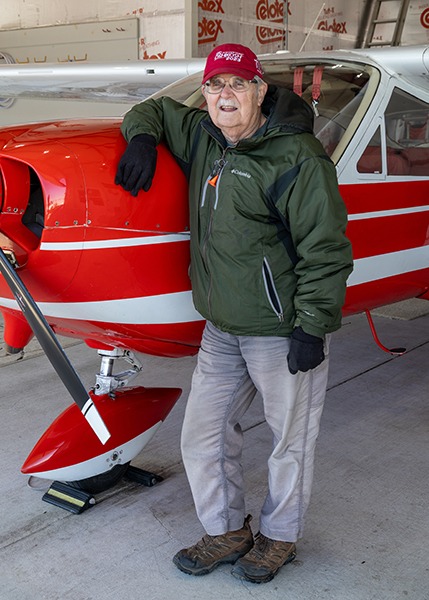
by Jim Bildilli
While my initial logbook perished in a house fire in 1979, some of the circumstances of my first solo remain quite vivid in my mind.
It all started at the age of 5 when I experienced my first flight in a J-3 Cub sitting on the lap of my uncle. Since then, I’ve always been fascinated with flying, and my occupational goal was to become a professional civilian or military pilot. Fast forward to entering middle school, my eyesight began to deteriorate and the need to wear glasses quickly doused any hope of ever meeting my goal. Of course, since then, corrective lenses, Lasik surgery and the easing of the “perfect” eyesight requirement have opened the door for others to reach the goal that was unattainable for me.
In 1964, I was accepted into the University of Illinois Civil Engineering program with Transportation as my major. At that time, the university’s Chicago Campus was located at Navy Pier. The only complaint was that there was only one, 5/8-mile-long hallway and every 50 minutes, you’d pass nearly 5,000 of the attending students. Besides being an active pier, you got to experience the smell of rotting animal hides being shipped to Italy to make shoes and the sound of forklifts and trucks while trying to hear the instructors due to the open windows and no air conditioning.
After one year, classes were moved to the “Circle” campus which is better known today as the U of I’s Chicago Campus. Upon finishing the available courses, I transferred to the main campus at Champaign-Urbana where I could complete my engineering studies. Also located in Engineering Hall was the Institute of Aviation’s offices and classrooms which re-kindled my interest in learning to fly. At the time, Professor Moreland Herrin started an airport planning and design course for transportation majors. Of course, I signed up for it, along with about 12 other students. Only Cal Tech and MIT offered an airport planning and design course.
As the end of the first semester neared, there appeared a notice on the Institute of Aviation’s bulletin board which stated that it was going to open 15 flight instruction opportunities to the entire student body for the second semester. Of course, it was open to the first 15 students who signed up and could pass a Class III physical. Much like obtaining football or basketball tickets at that time, you had to sign a ledger on the institute’s door and then “guard” your position. With a little help from some friends, I was able to secure one of those positions.
Come the second semester, I had my academic schedule which included ground school three days a week with flying on Tuesdays and Thursdays. The fees for flight training up to the Private Pilot Certificate were $375 for approximately 40 hours. If you wanted to rent one of the aircraft, that was $7/hr. wet. The downside was having to ride a school bus from the engineering campus to Willard Airport several miles south of Champaign, Ill.
The first two weeks of the semester were solid IFR. Needless to say, most of us spent our time flying WWII surplus Link trainers with an occasional break by flying a surplus WWII contact Link trainer. After two weeks, most of us could fly an IFR “Iron Cross” design that was printed out on a huge map table. Sometimes, if you made too steep a turn, the Link wouldn’t respond to your correction, and you had to lift the cover and yell for assistance to push the trainer upright. Much like the Link trainers that we were using, the instructional buildings were also war surplus Quonset huts.
Eventually, the weather cleared and we were able to move from the Link trainers to “real” aircraft. Of course, my first flight was “under the hood.” I guess the instructors figured that we had spent so much time in the Link, that it would seem familiar. My flight instructor was Alan C. Davis and using the instruments and a little coaching from the back seat of the Aeronca, we took off and spent the next hour doing maneuvers. Mr. Davis gave me headings back to the airport and the current active runway. It wasn’t until we were about a quarter mile from the threshold that he had me take off my glasses and do a “follow through” to a landing.
The next few weeks were filled with learning stalls and other maneuvers until one day he asked me to taxi toward the control tower. As soon as we stopped, Mr. Davis told me to let him out of the plane and do three take-offs and landings, just like we’ve been practicing. It was then that I realized I was ready (at least in Mr. Davis’ mind) to solo. Because this was the days before handheld radios, he went to the tower cab to have access to a radio in case things didn’t go well. The aircraft’s radio was a Narco “coffee grinder” with only five “crystals,” but it worked well, as long as I didn’t go anywhere that had different frequencies.
It was in the late afternoon, and I completed my solo and actually kept my shirt tail. As noted previously, I have no record of the date of my solo, nor the “N” number of the aircraft or any pictures due to the fire. The institute had several Aeronca 7 FCs that were equipped nearly identical. So, it was unusual to have the same aircraft on a regular basis. However, I do remember my flight instructor’s excellent teaching abilities, although that sometimes included a couple of “slaps” on the back of the head with a folded aeronautical chart, as feedback to emphasize a particularly bad maneuver on my part. I’m not sure what the instructors were paid, but Mr. Davis also drove a bus for Peoria Charter Bus Co. on his days off. We haven’t stayed in touch, but Mr. Davis is a founding member of the Society of Aviation Flight Educators (SAFE), a representative of the FAA’s FAASTeam in the Denver FSDO area, and the Director of Safety, Training & Quality Control for Integrated Airline Services, Inc.
Editor’s Note: Jim Bildilli is a retired State Aeronautics official with the Illinois Department of Transportation and active in Aviation Exploring, airport consulting and is a member of the Aviation Advisory Boards of Southern Illinois University and Lincoln Land Community College. He resides in Springfield, Illinois.
Share your story about your “First Solo” by emailing midwestflyer.com@gmail.com. This series was started January 1, 2026, you can view more articles like this by clicking here.