
Growing up in an aviation family has its benefits and its drawbacks. The advantages are numerous. Having both a father and grandfather as flight instructor is one. Certainly, having access to the family flight school aircraft is another. But with those benefits came expectations. My first solo for instance.
My Grandfather, Howard Morey, soloed when he was 20 years old. His first solo was in 1923 in a Curtis J1 Standard bi-plane. Grandpa was taking the commercial pilot program from Heath flying school in Chicago and had all of four hours of dual instruction prior to solo.
My Father, Field Morey, soloed at the age of 15. This occurred in 1953, in Manzanillo, Mexico during a family vacation. Dad soloed a year early as my grandfather felt he was ready, and the CAA, (Civil Aviation Authority’s) rules did not apply in Mexico. The Cessna 195 dad soloed is not an aircraft known to be forgiving on landing! (For a more detailed account of my father’s first solo see his book “Four Years Above the Earth, ISBN 978-1-6624-2298-D).
The CAA was replaced by the FAA in 1958, the year I was born.
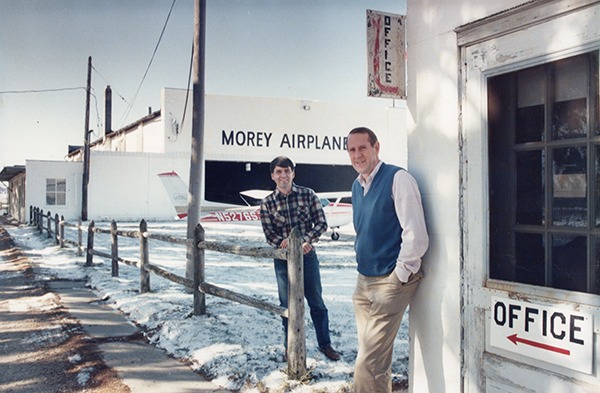
From the beginning, the expectation was for me to take my first solo flight on my 16th birthday. This was more of a given then a choice. The son of Field Morey, and the grandson of Howard Morey, I would of course solo as soon as it was legal for me to do so. To this end, I started flying lessons. My first lesson was February 11th 1974, a month and some change prior to my 16th birthday.
The night before my birthday was a bit hectic. The family was moving from the duplex I had spent 14 of my almost 16 years in, to a house in the country. Packing and logistics were front and foremost. My impending solo seemed overshadowed by the packing. The late March weather was not kind. Below zero for a high, and strong winds. As I carried boxes into our new house, I felt disappointment as I was sure my solo would be rescheduled for a nicer day. That was not my fathers plan though. We had a full house of friends and family, most of which had helped us move, and all eagerly awaiting the birthday and first solo party upon my triumphant return. No pressure…
The strong winds had not diminished during the day. I was apprehensive. Despite having spent most of my lessons practicing cross wind landings, the winds were definitely pushing my personal limits. I don’t remember pre-fighting our 1969 Cessna 150 Aerobat, N8340M. I do remember going around the patch three times with dad. As I recall my landings were not good. The kindest way to describe these three landings was that I did not get blown off our rather narrow runway. After the third landing, Dad told me to taxi to the ramp. I was devastated, as I was sure he was not going to solo me that day. We taxied in and I went to shut down. Instead, he told me to take the airplane up and do three full stop landings. He proceeded to exit the aircraft.
I could not believe it!
First solos tend to focus a student pilots’ attention on the matter at hand. In those days Morey airport consisted of two grass strips which were unusable in the winter and spring, and one 38 foot wide 3000 feet long paved runway. Despite the below zero temperature that day, the paved runway was essentially surrounded by mud. Holding center line was paramount in my thoughts.
It was not quite a direct crosswind, more like 70-degrees, with the wind gusting up to 20 knots. As I taxied to the runway a gust buffeted the little 150. This did little for my confidence. I kept in mind that my father had just signed my logbook so he must have confidence in my landings. I was both proud of his confidence in me, and very aware that it was up to me to live up to that confidence. I held short of the runway stopping at an angle where I could see base and final, taking a moment to compose myself. I made my radio call, “Morey traffic, November 8340 Mike departing runway 31, remaining in pattern.” then waited for a few seconds as I had been taught. “Don’t start taxiing onto the runway while making the radio call Rich, one day you will miss seeing the aircraft on short final! By waiting you give them a chance to call and let you know. This avoids making them go around or a potential accident.”
What anxiety I felt left me once I started my first takeoff roll. My father’s words again echoing in my head: “Aileron into the wind, rudder to hold centerline, airspeed alive, ailerons neutral as you as rotate Rich.” I climbed out through the structural turbulence still hearing Dad’s voice in my mind. “In turbulence hold a few knots extra on climb to compensate for the gusts.” I turn crosswind, then downwind, making my radio calls during each turn. “You are most visible in a turn Rich; your wing is down and anyone in the pattern will know where to look if you call while turning. Making a call downwind is not as specific or as useful.”
In those days our pattern altitude was 800 feet above ground level, not the current 1000’. I noticed how quickly I arrived at pattern altitude without Dad physically on board. Mid-field downwind I added carburetor heat. 150’s have Continental O-200 engines which are known for their predilection to form carburetor ice. Dad’s voice again, “Get the carb heat on early to help prevent icing.” Quickly I was opposite where I wanted to touch down. Everything seemed to be happening faster than when Dad was on board. “Opposite point of touch down, throttle to idle, three shots of nose up trim, establish best glide, all without losing an inch of altitude, then add flaps.” I add 10 degrees of flaps and turned base leg. Dads voice again, “this is your key position in the pattern, does it look about right? If high add flaps, if low add power, remember your pitch holds airspeed, if you raise the airplanes nose you slow down, lower it and you speed up…” I made the radio call as I turned, “fly first talk last, never drop the airplane to fly the microphone”.
My turn to final was shallower than normal to compensate for the cross wind was pushing me away from the runway. “Work with the wind Rich, use the prevailing conditions to help you rather than having to fight them.” That didn’t work out quite as well as I had planned, as I under estimated the crosswind. “The first one (pattern, landing) is for calibration Rich, see how it goes and adjust your pattern.” Once on the extended centerline of the runway, I put the aircraft into a slip. “Upwind wing low to offset the drift, opposite rudder in enough to keep the nose of the aircraft on extended centerline, and don’t forget to add five knots to compensate for the indicated airspeed error caused by the relative wind hitting the pitot tube at an angle.” Working the rudder and ailerons I compensated for both gusts and the diminishing of wind velocity as I descended. “Pick a target about 200’ in front of where you want to touch down. If the target stays in the same spot on your windscreen while you hold your airspeed, you are on glideslope…”
As I started the round out, my eyes went from my target to down the runway. “Look long in the flair, it opens up your peripheral vision which allows you to judge your sink rate.” I held it off, allowing the 150 to settle onto the runway, upwind main wheel first, then downwind main, followed by the nose wheel, and continued to apply upwind aileron to keep the aircrafts weight as much as possible on the upwind main wheel. “Follow through with the aileron, do not stop flying the aircraft just because you are on the ground!” I tracked as close to centerline as I was able, working the rudder. Once I came to a stop, I made my radio call and back taxied. “Flaps up, carburetor heat in, re trim for takeoff once you are stopped, then double check before you take off. Check twice to make sure.”
The other two landings went as smoothly as the first. Dad had faith in my abilities, more so than I did. In reviewing my logbook, I can understand why Dad had confidence. I soloed on my 9th lesson, and had all of six hours and fifty-five minutes of dual logged in the previous 40 days. This was not all that unusual for the time, before the FAA sensibly added the current requirements for solo, student pilots generally soloed under 10 hours. Of those nine lessons, five had been focused on slips and cross wind landings. The training paid off.
I do not remember much about the birthday/solo party that followed. There were several pilots in attendance and of course all generously shared their first solos stories in great detail! The difference this time was I had my own story to tell!
Editors Note: Share your story about your “First Solo” by emailing midwestflyer.com@gmail.com. This series was started January 1, 2026, you can view more articles like this by clicking here.
